At your service in Chandler
Emergency Generator Repair Chandler AZ
- Permit paperwork handled for you
- HOA approval sorted before install
- Serving Chandler & Gilbert homes
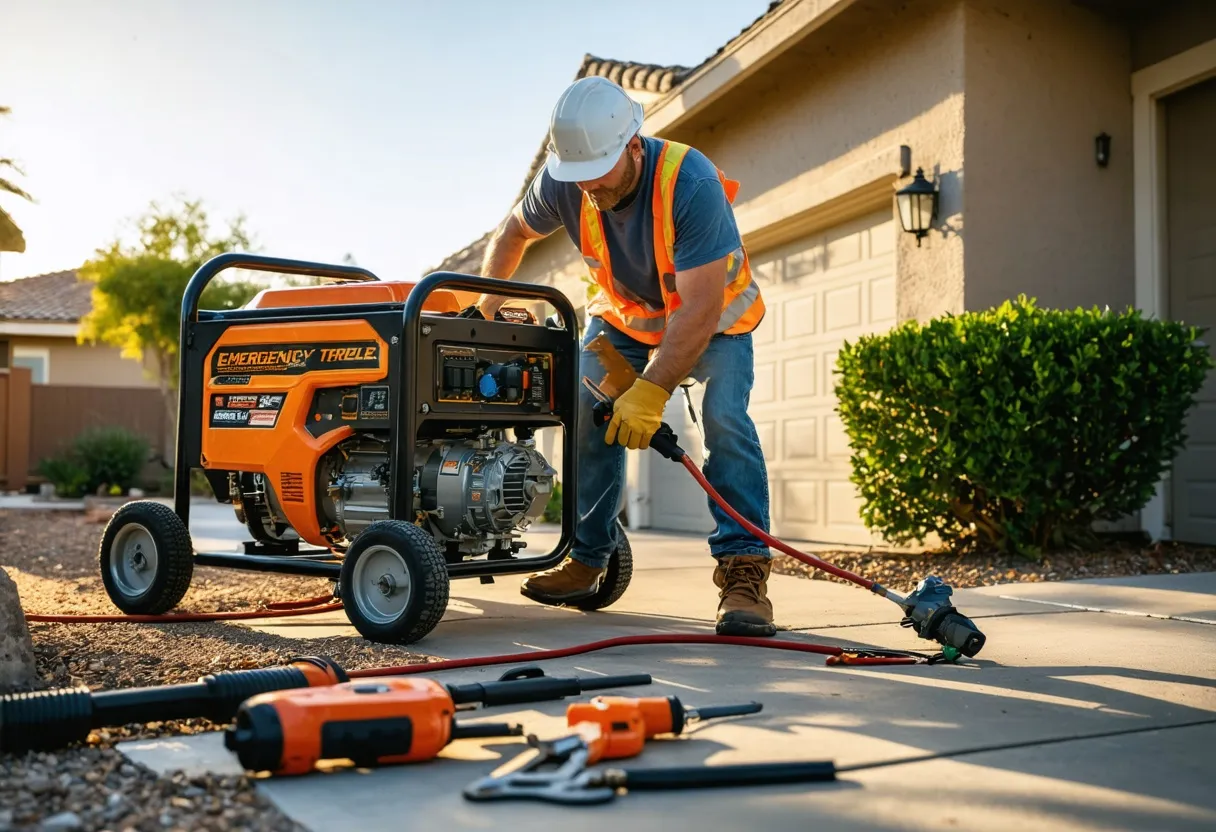
It's 9 PM, the wind just took out three transformers between Chandler and Gilbert, and your standby generator either isn't cranking or it's running but never handing power over to the house. Emergency generator repair in Chandler, AZ exists for exactly that window — no-start faults, transfer switches stuck between utility and generator power, fault codes you've never seen, all of it happening while the power's already out and the clock matters.
What separates a fast fix from a repair that quietly turns into a compliance mess is whether anyone checks, on that same first call, whether the fix touches the City of Chandler's Generator Permit rules or your HOA's architectural approval process. A transfer switch swap or a new panel connection made without that check can leave you with a working generator and a paperwork problem discovered weeks later. This page walks through the actual repair process, what's a true emergency versus a scheduled fix, and the permit-and-HOA questions Chandler homeowners ask when the power's out and the generator isn't cooperating.
What Happens Between Your Call and a Running Generator
We ask for fuel type, generator brand, and what the control panel is showing — blank, fault code, or nothing — so the technician rolls with the parts most likely to solve it already on board.
On-site, the technician checks the battery and charging circuit, tests fuel delivery under load, and inspects the transfer switch for backfeed risk before touching anything downstream of the panel.
If the fix means replacing the transfer switch or changing the electrical connection point, the City of Chandler Generator Permit filing — and the HOA architectural submission if your community requires one — starts that day, alongside the physical repair, not after it.
The unit gets run under real or simulated load and the transfer switch is cycled both directions, utility-to-generator and back, before the job is considered closed.
Signs You're Dealing With a Generator Emergency, Not a Maintenance Item
Why a Repair Stalls in Chandler When the Permit Step Gets Skipped
The pattern shows up across Chandler subdivisions more often than it should: a repair that should have wrapped in a day instead drags into weeks — not because a part was backordered, but because nobody flagged the permit or HOA requirement until the mechanical work was already finished.
What actually triggers the permit
Not every repair needs a City of Chandler Generator Permit. Clearing a fault code, replacing a battery, or fixing a fuel line generally doesn't touch anything the city inspects. The line gets crossed the moment a repair involves swapping the transfer switch, changing the electrical connection to your panel, or replacing the generator unit itself — at that point it falls under the same permit requirement as a new install. The issue isn't the permit process; it's that most repair calls don't get flagged for it until the technician is already mid-job, which is how the paperwork starts late and the inspection queue starts even later.
Why HOA sign-off catches people off guard
A second, separate bottleneck runs through Chandler's HOA-governed communities. If your generator equipment is visible from the street, or a repair changes its footprint, placement, or screening, several subdivisions require architectural committee sign-off alongside the electrical work, not after it. Homeowners who don't know that going in sometimes end up with a completed, working repair and an HOA letter asking them to relocate or re-screen equipment that's already wired into the panel.
The reason the code exists at all
Underneath both requirements is a real safety issue: a generator tied into your wiring without a properly functioning transfer switch can backfeed power onto utility lines — potentially the same lines a line crew is working to restore during the outage that took your power out in the first place. That's why a transfer switch, manual or automatic, is required on any generator connected to a home or business's electrical system, and why every transfer switch repair or replacement includes a check of the neutral-ground bonding and grounding path, not just whether the unit powers on.
None of this is theoretical during Chandler-Gilbert's monsoon months. The corridor takes a disproportionate share of the East Valley's storm-driven grid interruptions between roughly June and September — exactly the window when no-start calls and transfer switch faults cluster, and exactly when a stalled permit or HOA review costs you the most.
What Chandler Homeowners Ask Before Calling for Emergency Repair
Emergency calls are handled as they come in, day or night, with dispatch prioritized by proximity and current call volume across Chandler's zip codes. If you're unsure where you fall in the queue, ask directly on the call rather than guessing.
If it's safe to do so, confirm the fuel supply valve is open on propane or natural gas units and that the battery disconnect switch is in the "on" position — both are common, easy-to-miss causes of a no-start after maintenance or a tank swap.
No — it depends on what the repair touches. Battery, fault-code, and fuel-line fixes generally don't trigger a new permit. Transfer switch or panel-connection work does, and that filing starts the same day the problem is diagnosed.
The physical repair proceeds on the same emergency timeline as any call. If the work changes the generator's footprint, placement, or visibility, the HOA architectural paperwork is submitted in parallel rather than held until after the repair is finished.
Not necessarily. Repeated stalling under load can point to a fixable fault — fuel delivery, a failing component, a control board issue — or it can indicate a unit that was undersized for the home to begin with. Diagnosis determines which one you're dealing with before any replacement conversation starts.
Emergency calls are handled across Chandler's zip codes, including 85224, 85225, 85226, 85248, 85249, and 85286. If you're near a boundary and unsure, call and you'll get a direct answer rather than a guess.
Permit-Cleared Before We Touch Your Panel
Any emergency repair that reaches your transfer switch or panel connection gets flagged for City of Chandler permit and HOA review on the same call it's diagnosed — not weeks later. You get a generator that actually works and a repair that will pass inspection, without chasing city forms or an HOA board while the power's still out.
Serving the Chandler-Gilbert Monsoon Corridor, Zip by Zip
Emergency generator repair calls come in from across Chandler — 85224, 85225, 85226, 85248, 85249, and 85286 — and the same pattern holds in every one of them: outages cluster with monsoon activity moving through the Chandler-Gilbert corridor, and the generators that fail are almost always the ones that haven't been exercised or load-tested recently. A unit sitting idle for months tends to reveal a weak battery, a stuck fuel valve, or a transfer switch that hasn't cycled in a while — exactly at the moment you need it not to fail.
It's also common on older or previously DIY-installed systems for an emergency call to surface an installation that was never brought fully up to code — a transfer switch wired without proper isolation, or a neutral-ground bonding mismatch causing nuisance tripping. When that turns up mid-repair, it gets explained plainly, with the reasoning behind what needs correcting, rather than presented as a surprise upsell.
If your generator runs fine and just needs the kind of attention that prevents an emergency call in the first place — battery health, fuel system condition, a real load test — that's routine maintenance rather than repair, and it's what keeps most Chandler households off this page altogether heading into the next monsoon season.
Get Your Free Quote
Tell us about your property and we'll lay out the permit, HOA, and install plan — no obligation.
Ready to Get Cleared for Installation?
Start with a free quote and we'll map the permit and HOA steps specific to your property.